Retesting Fran every couple of months only helps if you can compare the results. Between a whiteboard photo lost in your camera roll, a time scribbled in a notebook and the day you dropped the weight, it quickly becomes hard to tell whether 4:30 is really a PR.
In Grunty, the Analysis → CrossFit tab brings your sessions, WODs and benchmarks together for any period you choose. Every named WOD, such as Fran, Cindy, DT or Murph, keeps the history of all its attempts, with each score in its own unit: a time for For Time, rounds and reps for an AMRAP.
One rule drives the whole screen: a score is only compared with a score from the exact same logged workout. That is what makes the ‘New PR’ badge trustworthy. Every screenshot in this article is a real screen from the app, in the English interface.
Why a benchmark only matters when it is comparable
Benchmark WODs are designed to be repeated. Their content is fixed: Cindy, for instance, is a 20-minute AMRAP of 5 pull-ups, 10 push-ups and 15 squats 1. Performed under standardized conditions, these tests are reproducible: a study of the Fight Gone Bad benchmark reports excellent test-retest reliability for its total score 3.
Reference values have even been published for benchmarks such as Fran, Grace and Helen, based on scores self-reported by athletes 4. But all of these numbers assume the same thing: that the WOD was performed as prescribed.
- Fran at 30 kg is not Fran at 43 kg.
- Murph with a weight vest is not comparable with Murph without one.
- A For Time stopped at the time cap has no final time.
- A scaled version is still a different version, even with the same name.
The CrossFit progress dashboard: four numbers that matter
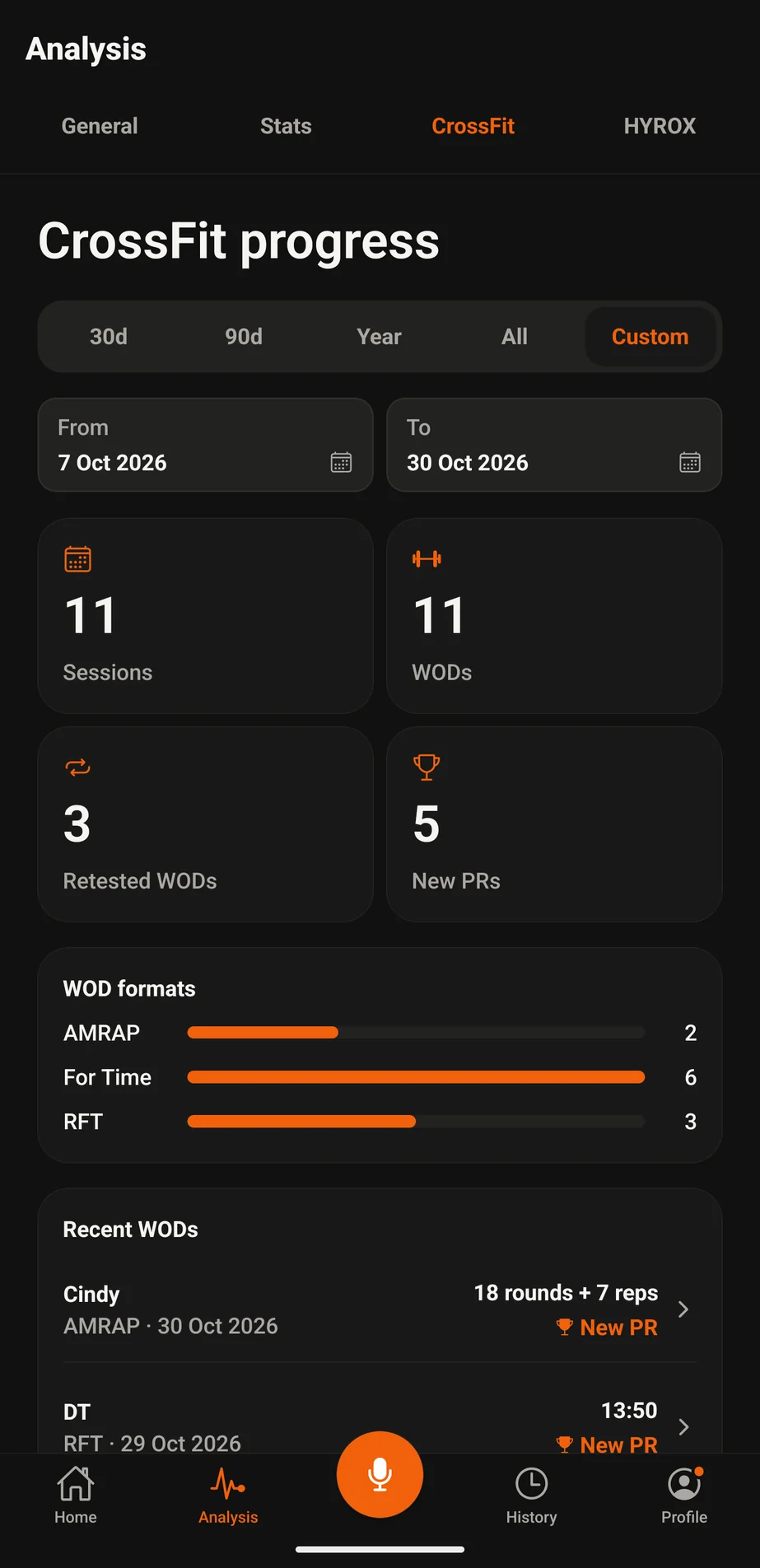
At the top of the CrossFit tab, four counters summarize the selected period. In the custom range shown above, from 7 to 30 October: 11 sessions, 11 WODs, 3 retested WODs and 5 new PRs.
| Metric | What it represents |
|---|---|
| Sessions | CrossFit sessions logged during the period. |
| WODs | Identified WODs. A session can include several: a main WOD and a finisher count as two. |
| Retested WODs | WODs you repeated, the ones that actually let you track change. |
| New PRs | Attempts that beat your previous best on the exact same workout. |
Any period, down to the day
The 30d, 90d, Year and All filters cover everyday use. Custom opens a calendar where training days are marked with a dot: pick a start and an end date to isolate a training block, a strength cycle or the weeks before a competition.
WOD formats at a glance
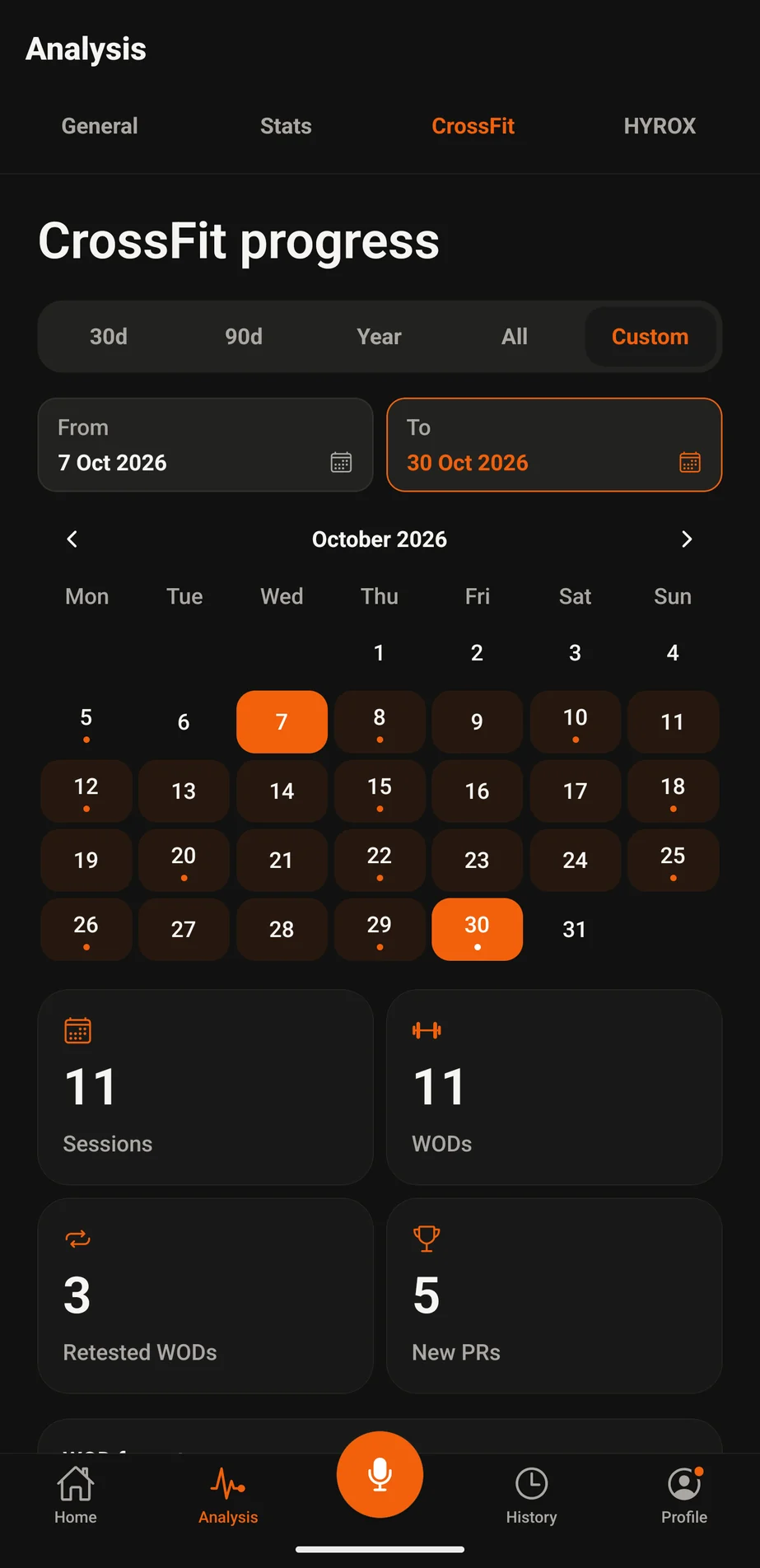
The WOD formats card shows how your WODs split between AMRAP, For Time and RFT (rounds for time): 2 AMRAPs, 6 For Time and 3 RFT in this range. Multimodal workouts vary widely in duration, structure and outcome measure 5, so a program built almost entirely on short For Time pieces is easy to spot here.
Recent WODs: every score in its own unit
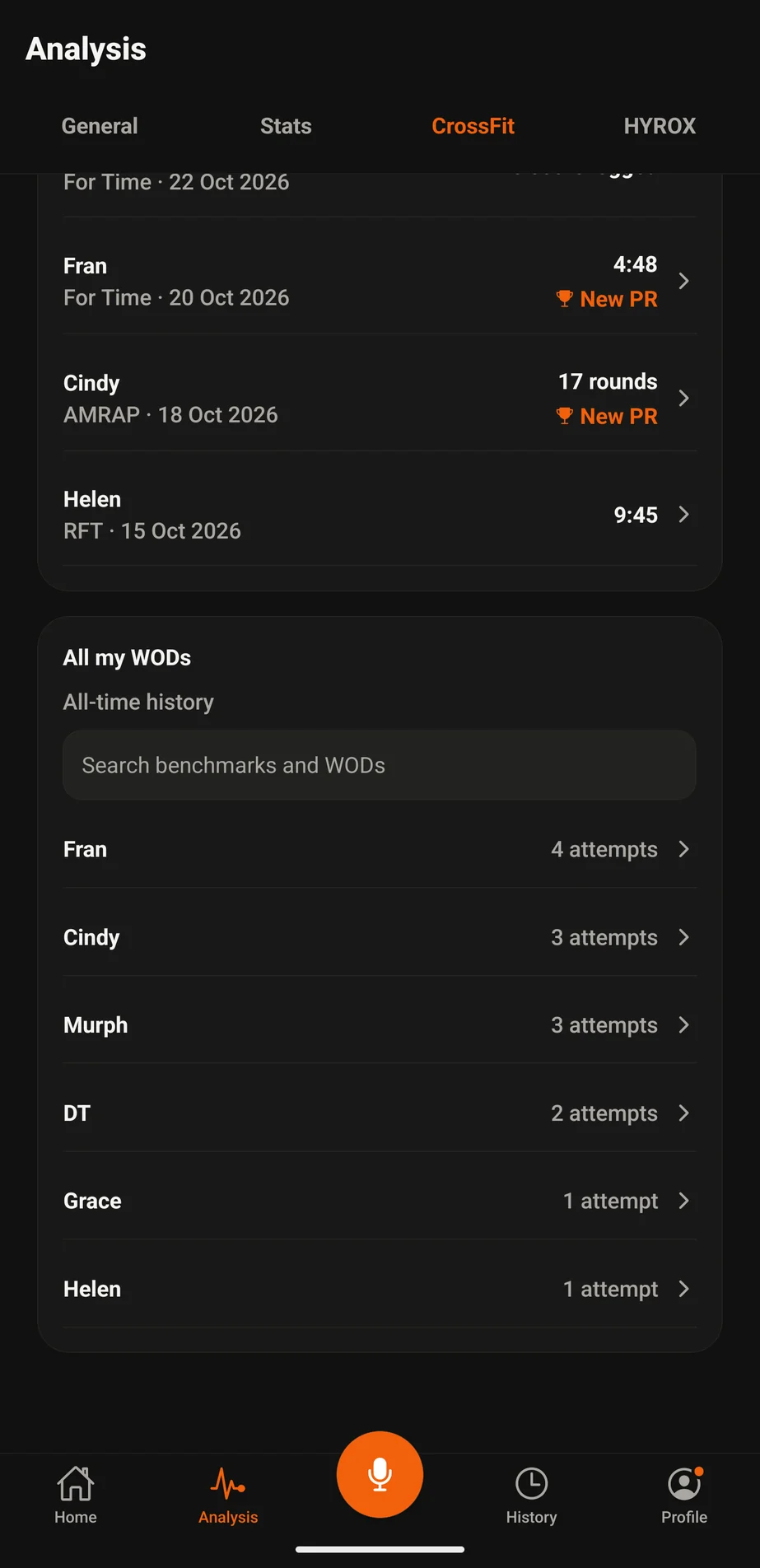
The Recent WODs list shows each WOD’s name, format, date and score, newest first. An AMRAP is scored in rounds and reps within a fixed time, a For Time by how long it takes to finish the prescribed work 2. Grunty keeps that distinction:
- For Time: the final time, such as Fran in 4:20 or Murph in 49:37.
- AMRAP: full rounds plus the reps of the unfinished round, such as Cindy at 18 rounds + 7 reps.
- RFT: the time to complete the prescribed rounds, such as DT in 13:50.
- No score logged: shown as is when no result was entered, as for Grace in the screenshot. No number is made up.
The New PR badge marks attempts that beat your previous best on the same version of the WOD. A row without a badge is not necessarily worse: it may be a first attempt, or a different version of the same WOD.
All my WODs: one benchmark, every attempt
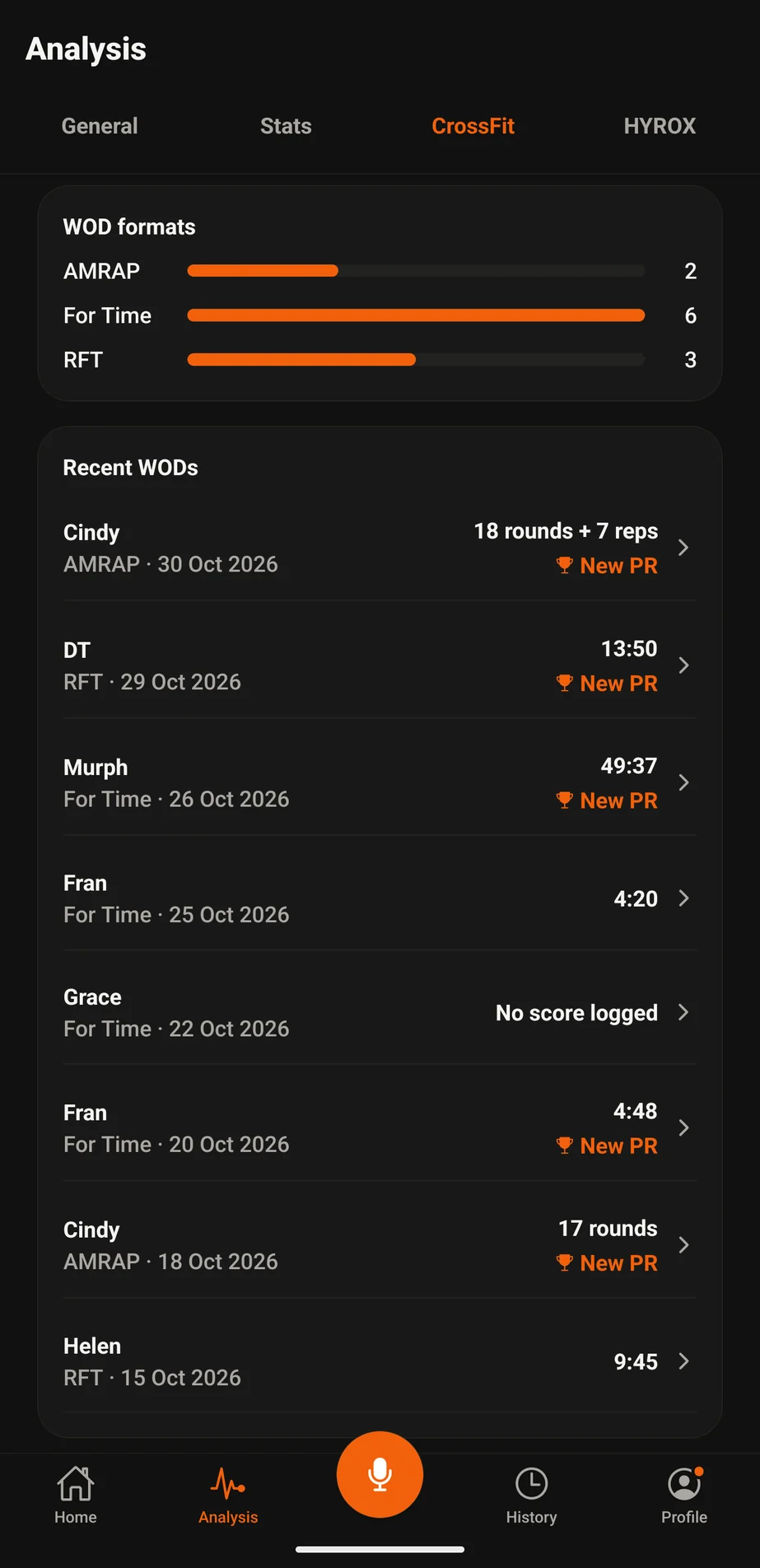
Below the recent WODs, the All my WODs card covers your all-time history, whatever period is selected. Each benchmark appears once with its number of attempts: Fran 4, Cindy 3, Murph 3, DT 2, Grace 1 and Helen 1.
The Search benchmarks and WODs field takes you straight to any WOD, even one you rarely program. Tap it to open its full history.
The rule behind a reliable PR: same workout, same comparison
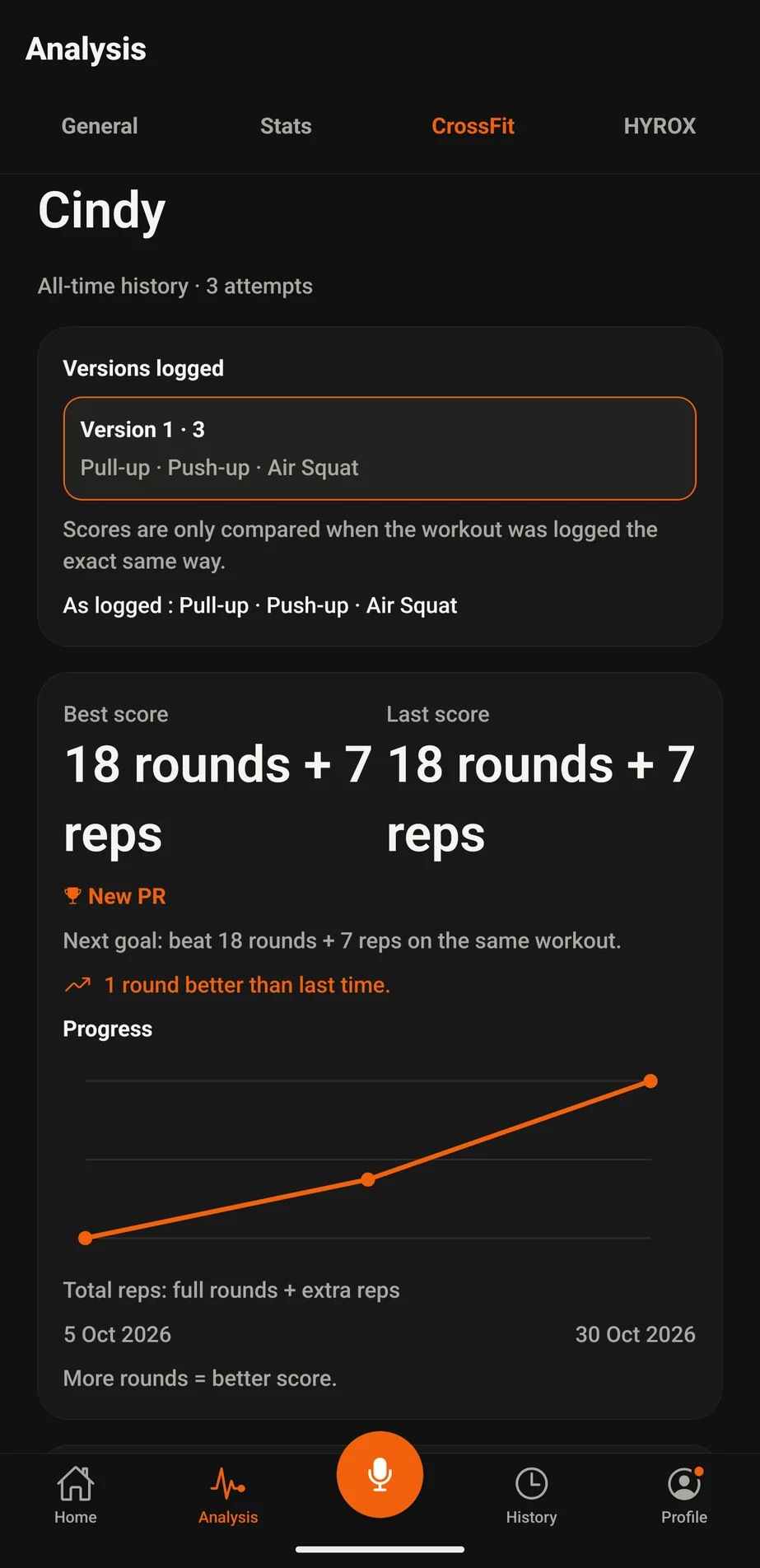
A benchmark’s page starts with its versions logged. Grunty groups attempts performed with exactly the same protocol: same movements, same rep scheme, same loads. For Cindy, the screenshot shows a single version (pull-ups, push-ups, air squats) logged 3 times.
Scores are only compared when the workout was logged the exact same way.
In practice, comparisons follow simple, verifiable rules:
| Situation | What Grunty does |
|---|---|
| Fran Rx repeated at Rx | Compared: same movements, same 21-15-9 scheme, same load. |
| Fran done with a different load | Kept in your history, but only compared with attempts at that load. |
| Murph with a weight vest | Treated as a separate version from Murph without a vest. |
| For Time not finished or over the time cap | No final time recorded, so no PR. |
| AMRAP with the same number of rounds | Tie broken by the reps of the unfinished round, when they are expressed as reps. |
| Rx Men / Rx Women not confirmed | The loads actually logged are used for comparison, and the attempt stays flagged. |
That is why a faster time can appear without a PR badge: done in another version of the WOD, it does not beat the record of the reference version. It is also why the first attempt at a benchmark never shows a PR: there is no score to beat yet.
Reading a benchmark’s progress: Cindy in three attempts
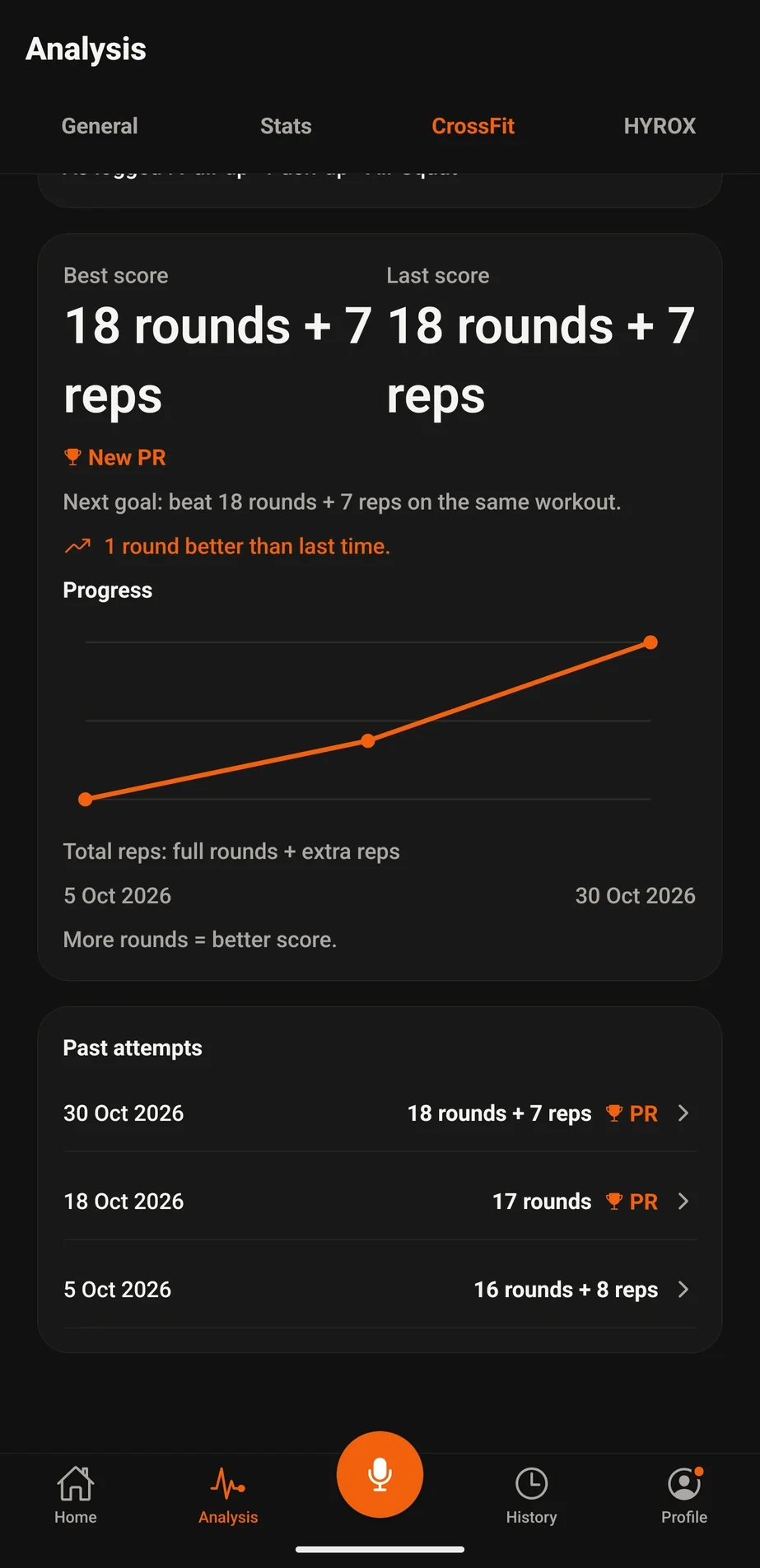
Below the versions, the page shows your best score, last score, next goal and the change since your previous attempt. The Progress chart plots every attempt of the selected version.
| Date | Score | Total reps | Status |
|---|---|---|---|
| 5 Oct 2026 | 16 rounds + 8 reps | 488 | First attempt |
| 18 Oct 2026 | 17 rounds | 510 | PR |
| 30 Oct 2026 | 18 rounds + 7 reps | 547 | PR |
For an AMRAP, the chart uses total reps: full rounds multiplied by 30 reps (5 + 10 + 15), plus the reps of the unfinished round. 18 rounds + 7 reps therefore equals 18 × 30 + 7 = 547 reps. This only works because every movement in Cindy is counted in reps.
In 25 days, the score went from 488 to 547 reps: +59 reps, roughly two extra rounds. The app sums up the change since the previous attempt (‘1 round better than last time.’) and sets an explicit target: beat 18 rounds + 7 reps on the same workout.
For a For Time workout like Fran, the logic is the same in reverse: the best score is the shortest time. At the bottom of the page, Past attempts lists each attempt with its date, score and PR badge where earned.
Logging a benchmark so it stays comparable
Your history is only as good as what you log. A few habits go a long way:
- Name the WOD: ‘Fran 4:30’ or ‘Cindy 18 rounds + 7 reps’ is enough for Grunty to recognize the benchmark and its structure.
- Confirm Rx Men or Rx Women on loaded WODs, or enter the load you actually used if you changed it.
- State your modifications: weight vest, substituted movement, scaled version. They create a separate version instead of distorting your PRs.
- Give the unfinished round on an AMRAP: ‘18 rounds + 7 reps’ is more precise than ‘18 rounds’.
- Say whether you finished a For Time: a WOD stopped at the time cap is not ranked as a final time.
Log however you prefer: by voice, in free text, with manual entry or from a whiteboard photo with Premium. The dedicated guide to logging a WOD, linked at the end of this article, covers each method and the 28 recognized benchmarks.
Add a benchmark without dictating anything
On the Check your workout screen, the Create a group button also offers Benchmark WOD (CrossFit): search for Fran, Cindy, Murph or a movement, and the WOD comes in with its movements, rep scheme and Rx loads already filled in. Just adjust the load if needed and enter your score. The same menu adds a full HYROX simulation, with its 8 runs and 8 stations.
Frequently asked questions
Why doesn’t my first attempt show a PR?
A PR means beating a previous score. On the first attempt at a version, there is no reference score yet: that attempt becomes the score to beat.
Why isn’t a faster time marked as a PR?
Because it was logged with a different protocol: another load, another movement, a vest or an unfinished WOD. It stays visible in your history, but it is only compared with attempts of the same version.
Can I track a custom WOD without a benchmark name?
Yes, as long as it is logged with its format, movements and result. A custom WOD is compared with other attempts whose protocol is strictly identical.
Does the selected period change a benchmark’s history?
No. Period filters apply to the counters, the WOD formats and the recent WODs. The All my WODs list and each benchmark page cover your all-time history.
Are comparisons estimated by AI?
No. AI is used to understand what you log. Once the session is saved, CrossFit tracking applies fixed rules: same protocol, same score unit, and no made-up result when data is missing.
Which app should I use to track my CrossFit PRs?
One that keeps every attempt at a benchmark and only compares scores done under the same conditions. That is Grunty’s approach: history per WOD, PR badge only for an identical protocol, and logging by voice, text or a whiteboard photo. The app is free on iPhone and Android.
Is CrossFit tracking available in French?
Yes. The interface is available in English and French, with the same comparison rules.
Key takeaways
- A benchmark only measures progress when it is repeated under the same conditions.
- The CrossFit progress dashboard summarizes sessions, WODs, retested WODs and new PRs for any period.
- Every score keeps its unit: time, rounds + reps, or ‘no score logged’.
- The PR badge only appears on identical workouts, and never on a first attempt.
- Precise logging (WOD name, Rx, modifications, unfinished round) is what makes your history reliable.
Further reading
- Murph: standard, vest and scaled versions
- Fran: 21-15-9 thrusters and pull-ups
- How to Log a CrossFit WOD: Photos, AMRAPs, EMOMs and 28 Named Benchmarks
- How to know if you are progressing in the gym
- How to log Olympic weightlifting workouts
Sources and references
- 1. CrossFit — Cindy Benchmark (20-minute AMRAP, 5/10/15) ↗
- 2. CrossFit — CrossFit Terms Explained: AMRAP, For Time, benchmarks ↗
- 3. Durkalec-Michalski K. et al. — Evaluation of the repeatability and reliability of the cross-training specific Fight Gone Bad workout, Scientific Reports (2021) ↗
- 4. Mangine G. T., Cebulla B., Feito Y. — Normative Values for Self-Reported Benchmark Workout Scores in CrossFit® Practitioners, Sports Medicine – Open (2018) ↗
- 5. Solving the High-Intensity Multimodal Training Prescription Puzzle: A Systematic Mapping Review (2024) ↗
Screenshots taken in the Grunty app in November 2026. The comparison rules described reflect how CrossFit tracking works at that date. Published reference values for benchmarks are not individual targets.